Skip to content
CASE STUDY Product Designer · Legal Tech SaaS · Secure File Management

LitBox: the file layer three other Omnis AI products already read from.

AutoDoc needed documents to process. OmnisProof needed documents to sign. MedChron needed a way to attach one without leaving its own screen. None of them agreed on where a file actually lived — so I designed the one layer all three now call into directly, not just link out to.

Muzeeb Urrahaman Product Designer Legal Tech SaaS · Secure Storage Platform / Infrastructure Design IA × Security × Ecosystem Integration
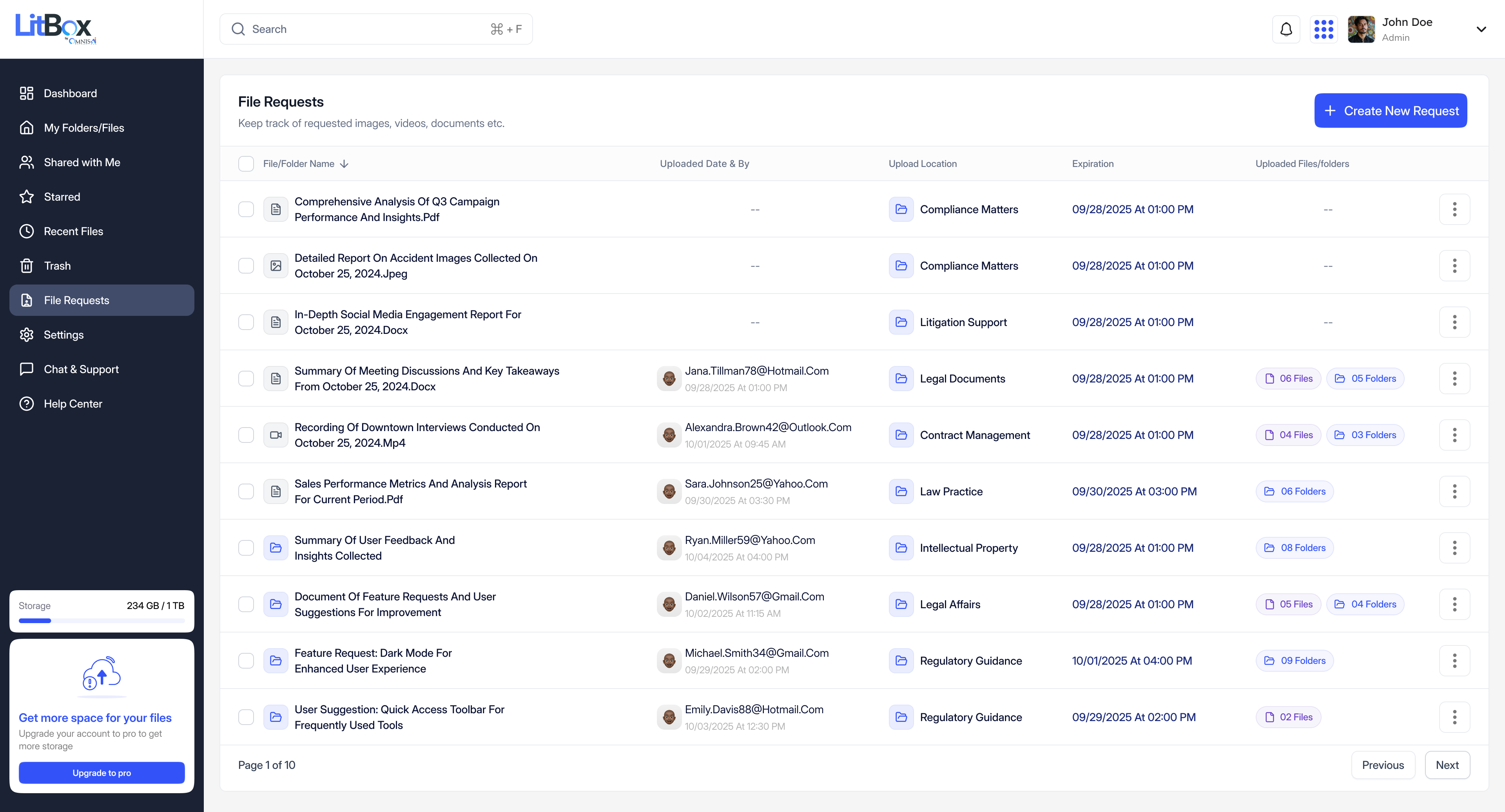
LitBox File Requests screen populated with ten active requests, each showing destination folder, expiration date, and submitted file counts
A real staging screenshot — the submitter names and emails are seeded test data, not real clients.
Role
Product Designer, End-to-End

Domain
Legal Tech SaaS · Secure Storage
Core Problem
Files Fragmented Across 4+ Tools
Status
Internal Beta / Dogfooding
01 / OVERVIEW
What Is LitBox

A file system organized around a legal matter, not a generic folder tree

LitBox is the secure file management layer inside Omnis AI's legal tech platform — one place for a firm's documents, evidence, and case media that the rest of the ecosystem is designed to read from and write to, instead of each product holding its own disconnected copy.

On the surface it looks like the category it has to compete with: a Drive- or Dropbox-style workspace with folders, previews, sharing, and search. The difference is what sits underneath. Every file in LitBox can carry a matter context, a permission model built for firm/team/client boundaries rather than personal accounts, and an audit trail — and, unlike a general-purpose drive, it was designed from day one to be a layer other products plug into, not an island.

Omnis AI already ships several purpose-built legal tools — CasePro (case and matter management), AutoDoc (document intelligence and processing), OmnisProof (e-signature), plus MedChron, LitDraft, CaseNotes, and DiscoPro. Every one of them touches files. Before LitBox, storage wasn't a first-party layer any of them shared — it lived wherever each product's team decided to put it, or outside the ecosystem entirely in whatever drive a firm already used.

The Opening Insight LitBox didn't start from a single support ticket or a usability session I ran. It started from a pattern across the other Omnis AI products I'd already worked on: AutoDoc needed a document to process, OmnisProof needed a document to sign, CasePro needed a document attached to a matter — and each one was quietly solving "where does the file live" on its own. The gap wasn't "lawyers need a nicer Dropbox." It was that the ecosystem had no shared file layer at all.
Product walkthrough. Dashboard → upload → File Request → search — the core loop, in motion.
02 / THE OPPORTUNITY
Why Build It

Why a legal AI platform needed to own storage, not rent it

A legal tech company adding "cloud storage" to its roadmap is an easy pitch to over-sell. So before treating it as obviously worth building, I separated what's actually documented from what's a reasonable-but-unproven hypothesis.

Every Product Needed Files, None Owned Them

  • AutoDoc's whole job is processing documents — it needs a reliable source for them.
  • OmnisProof needs a document to attach a signature workflow to.
  • CasePro needs evidence and case files tied to the matter record it manages.

AI Tools Are Only as Good as What They Can Read

  • Document intelligence and search only work on files the platform can actually see.
  • If evidence lives in five different tools, no single product can search across all of it.
  • A shared file layer is what makes cross-product retrieval possible at all.

Sharing Without a Record Is a Liability

  • A public link with no expiry, no password, and no log is convenient — and hard to defend later.
  • Firms handling privileged material need to know who touched a file, not just that it was sent.

Confirmed: AutoDoc's Documents-folder pickup and the in-document "Continue to e-signature" action are both built and working today. Not yet measured: how much time firms actually lose bouncing files between tools — no baseline exists yet, and I'm not inventing one.

What Law Firms Are Documented to Struggle With

This section draws on secondary research — published security and legal-tech sources — not on primary interviews I personally ran with lawyers. I want to be explicit about that distinction up front, because the rest of the case study depends on it.

Fragmented, Not Just Disorganized

  • Files split across email attachments, personal cloud drives, and case-management tools with no shared index.
  • The same document can exist in three places with three different names and no way to tell which is current.

Sharing Outruns Access Control

  • General-purpose drives make it easy to generate a public link and hard to audit who still has it.
  • Permissions are typically per-file or per-folder, not scoped to a legal matter or a case team.

No Matter-Level Context

  • A generic drive doesn't know a file belongs to Smith v. Jones — a firm has to rebuild that context manually, every time.
  • That's the exact gap a legal-specific layer like LitBox is positioned to close.

Research Limitations & Open Questions

In the interest of not overstating what this research package actually is:

03 / RESEARCH & SECURITY CONTEXT
Why It Matters

Why secure storage is a different problem for a law firm

A generic drive protects files. A law firm's drive has to protect privilege — client identities, litigation strategy, medical and financial records, and communications that are confidential by professional obligation, not just by preference. That distinction is what "secure storage" has to mean for LitBox, and it's worth grounding in real incidents rather than abstract risk language.

Five Documented Incidents, Checked Independently

These five cases were supplied to me as potential evidence. I verified each one rather than taking the dates and framing at face value — and in every single case, the date I was given turned out to be when a lawsuit was filed or a settlement was approved, not when the breach itself happened. That gap is worth sitting with on its own: notification and litigation timelines routinely run months to years behind the actual incident.

Blank Rome LLP

Breach: May 2026, not July 2026. An attacker posed as the firm's IT department and social-engineered an attorney into uploading files to an external Google Drive account. 57,554 individuals affected — SSNs, financial, and medical data. Two proposed class actions (Delapaz and Santana v. Blank Rome) were filed July 6, 2026 in E.D. Pa. — still pending.

Orrick, Herrington & Sutcliffe

Breach: March 2023, not November 2024 — hackers had network access for roughly two weeks. 638,000+ individuals affected, including clients of healthcare-sector entities. The $8M settlement (up to $2,500–$7,500 per claimant) received final approval in November 2024 — that's the date that was actually supplied to me.

WilmerHale

Breach: May 2026, not July 2026 — names and SSNs accessed by an unauthorized third party. WilmerHale states the attacker didn't directly access its systems and found no evidence of misuse. Perry v. WilmerHale was filed July 2026 in D.D.C. — still pending, not yet a confirmed settlement.

Pillsbury Winthrop Shaw Pittman

Breach: April 2025, not November 2025 — a social-engineering attack over a short window. Notification began November 2025, seven months later. Important correction: the proposed class action was not settled — three plaintiffs voluntarily dismissed their suit in S.D.N.Y. after a mediation attempt. I'm not treating this as a firm "loss" to cite.

Gunster, Yoakley & Stewart

Breach: November 2022, not November 2024 — suit filed May 2024, ~746,000 individuals affected. The $8.5M settlement received final court approval in August 2025, not November 2024. Numbers were right; nearly every date needed correcting.

Why I'm Not Using These as Marketing All five incidents targeted large, well-resourced firms with existing security programs — none of them prove LitBox would have prevented anything, and I'm not implying otherwise. What they do establish: social engineering, not exotic malware, was the entry point in at least three of the five, and every firm's own IT/security staff were the impersonation target. That's a specific, citable pattern — "harden the human workflow around file requests," not "buy more encryption."

The Ethical Baseline: ABA Model Rule 1.6 and Comment 8

Two provisions of the ABA Model Rules of Professional Conduct (adopted state-by-state, not federal law) are the actual ethical floor here. Rule 1.6(c), added in 2012, requires a lawyer to "make reasonable efforts to prevent the inadvertent or unauthorized disclosure of, or unauthorized access to, information relating to the representation of a client." Comment 8 to Rule 1.1 (competence), added the same year, requires a lawyer to "keep abreast of changes in the law and its practice, including the benefits and risks associated with relevant technology" — source: American Bar Association ↗. Most U.S. states have since adopted Comment 8 or an equivalent duty. Neither provision mandates a specific technology or certification — they require reasonable safeguards and informed decisions, which is a lower and more contextual bar than "encrypted" or "compliant," and exactly why I'm not attaching either of those words to LitBox without something to back them up.

What "Secure Cloud Storage" Actually Requires

Drawing on Clio's and Sync's own published security guidance (both are legal-software vendors describing their own practices, so I'm treating this as informative rather than independent research) plus CloudLex's incident-pattern write-ups: the baseline components are encryption in transit and at rest, multi-factor authentication, role-based access control, session management, audit logging, and a clear distinction between consumer-grade tools and ones built for legal-grade access control. Sync's own material is blunt about this gap: general-purpose consumer cloud tools are "designed for a broad audience" and often lack the audit trails and access controls firms specifically need. On vendor selection itself, CloudLex's piece on data-privacy certification makes the case that a vendor's own certifications matter when a firm is choosing who to trust with client data — a standard LitBox doesn't yet meet, per the note below.

What LitBox Does Not Claim LitBox does not currently claim SOC 2 certification, HIPAA compliance, zero-knowledge or end-to-end encryption, or attorney-client-privilege protection as shipped, verified capabilities. Encryption in transit and at rest, role-based permissions, and broader audit-export tooling are design targets reflected in the product's own module-architecture research — treat anything above not tied to a screenshot elsewhere in this case study as a proposed capability requiring technical and business validation, not a shipped guarantee. The one security-adjacent surface that is actually built and shown in this case study is the Audit Timeline in Section 09.
04 / COMPETITIVE LANDSCAPE
Why Not Just Use Drive or Dropbox

Established storage products aren't wrong — they're not built for a legal matter

Google Drive, Dropbox, and Box are mature, well-engineered products used by millions of people, including plenty of law firms. The honest question isn't "are they secure" — it's "do they model the thing a law firm actually organizes around: a matter, not a folder."
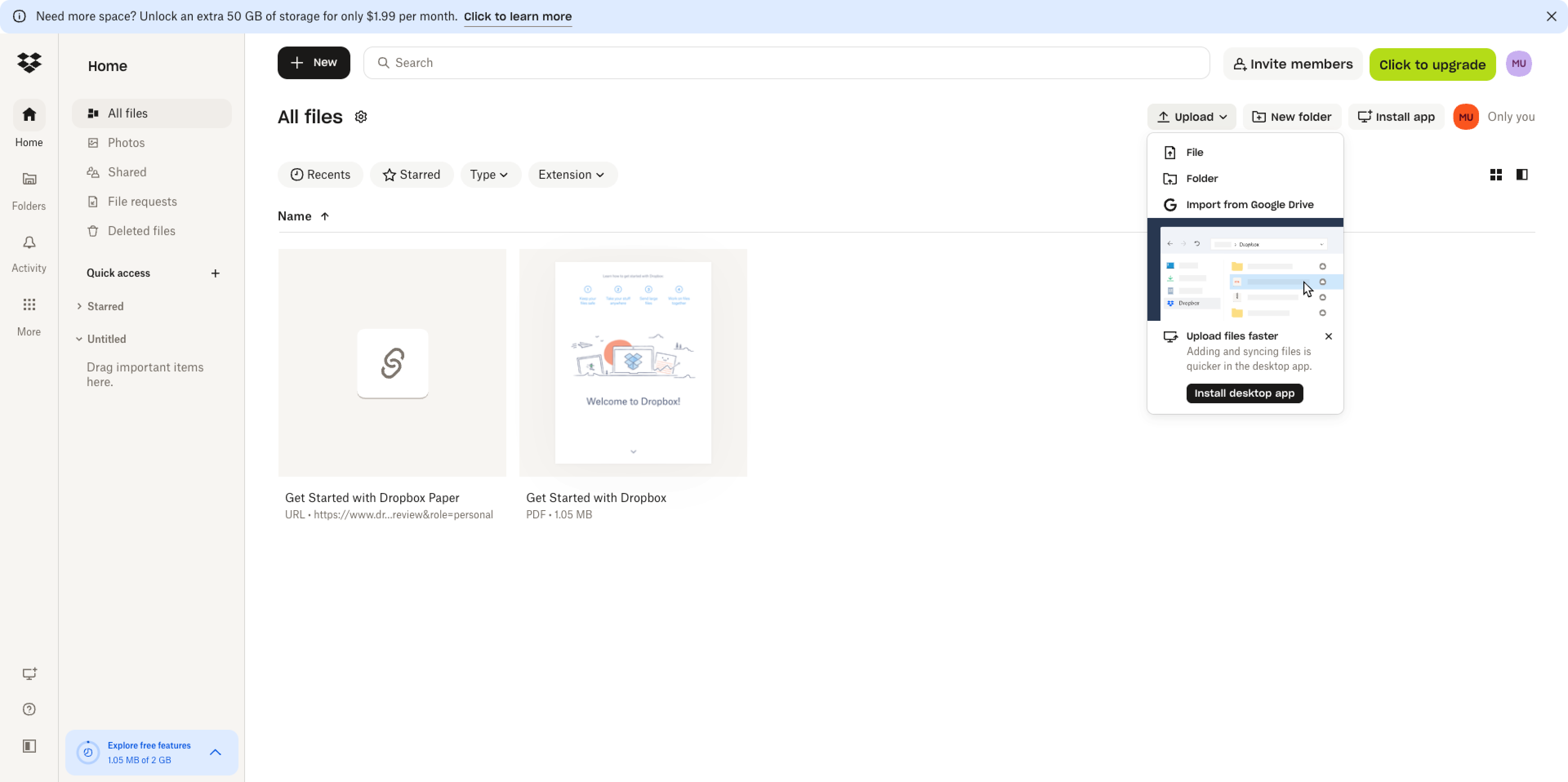
Dropbox All Files home screen, showing a generic folder-and-file view with an Upload menu open
ReferenceDropbox. Files, folders, and search — no concept of a matter, a case team, or a retention rule anywhere in the primary view.
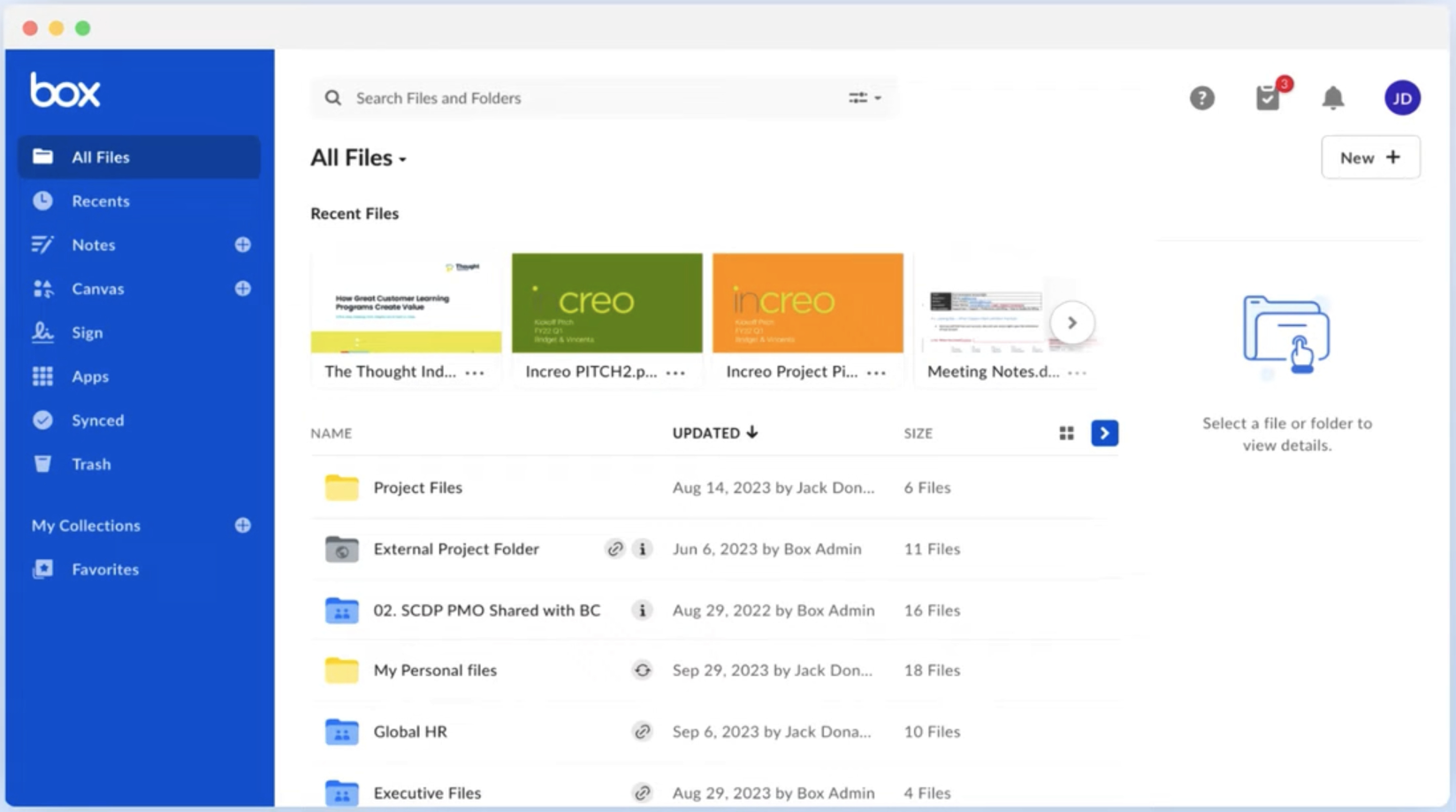
Box All Files home screen, showing recent files and a folder list organized by department names like Global HR and Executive Files
ReferenceBox. Stronger admin/governance tooling than Dropbox, but still organized by department and folder, not by legal matter.

Google Drive / Dropbox General Purpose

  • Reliable, familiar, deep integration with everyday office tools.
  • Sharing is file- or folder-scoped, not matter-scoped — a link can outlive the reason it was created.
  • No native concept of a "case," a retention policy, or a legal hold.
  • Search finds a file by name or content, not by which matter it belongs to.

Box Enterprise Governance

  • Strongest of the general-purpose tools on admin controls, retention, and compliance reporting.
  • Still organizes around folders and enterprise groups, not legal matters or case teams.
  • No native link into document processing, e-signature, or case-management workflows built for law firms.

Sync.com Privacy-First

  • Markets end-to-end/zero-knowledge encryption as a core differentiator for sensitive files.
  • Still a standalone drive — no matter context, no case-team permission model, no ecosystem it plugs into.

LitBox Legal-First

  • Files and folders behave the way Drive/Dropbox users already expect — same learning curve, familiar patterns.
  • Adds a matter-aware permission model, an audit timeline, and File Requests built for external submitters.
  • Connects natively into AutoDoc and OmnisProof today, with CasePro and the rest of the ecosystem as the roadmap.
Where LitBox Is Still Behind Drive, Dropbox, and Box have years of reliability data, mobile and desktop sync clients, and integrations LitBox doesn't have yet — Microsoft 365, Google Workspace, and a mature third-party app ecosystem among them. A firm already deep in one of those tools has real switching costs LitBox has to justify, not assume away.
05 / SOLUTIONS CONSIDERED
Options on the Table

Three places the shared file layer could have lived. Two were faster to ship — and wrong

Once "every product needs files and none of them own storage" was clear (Section 02), the fix wasn't obvious yet — it rarely is. These are the three real architectural paths I weighed, not a polished single recommendation dressed up after the fact.

A — Each Product Keeps Its Own Storage

  • LitBox becomes a thin UI opened from inside AutoDoc or CasePro — no shared backend, just a nicer picker.
  • Fastest to ship — every product already has some upload mechanism to build on.

Rejected — doesn't fix fragmentation, it just re-skins it. Every product still holds its own copy of a file, with no shared audit trail connecting them.

B — Fold Storage Into CasePro

  • Build file management as a module inside the case-management CRM, since matters already live there.
  • The "obvious" answer — CasePro already owns the concept of a matter.

Rejected — ties every other product's file access to CasePro's release cycle and permission model. MedChron and LitDraft would still need their own workarounds to reach a file.

C — A Standalone Layer, Embeddable Everywhere

  • LitBox owns a file once, and exposes a search/picker surface any product can call into — not just link out to.
  • Slower to ship than A, more independent than B.

Chosen — the only option where AutoDoc, OmnisProof, MedChron, and LitDraft can each connect on their own timeline, without depending on each other or on CasePro shipping first.

The Part I Didn't Expect to Prove Out Option C was a bet that other product teams would actually build against LitBox rather than route around it. Section 12's real staging screenshots — LitBox's search running live inside MedChron and AutoDoc — are the closest thing this case study has to that bet paying off.
06 / PRODUCT STRATEGY
Defining the Product

Turning research into a defensible scope, not a feature wishlist

Problem Statement

Law firms working inside the Omnis AI ecosystem have no shared, secure place to store case files — so every product either builds its own storage or depends on a general-purpose drive that has no concept of a legal matter, a case team, or an audit trail.

Opportunity Statement

A file layer purpose-built for legal matters — with familiar Drive-like interaction patterns — can become the shared foundation the rest of the ecosystem reads from and writes to, instead of each product solving storage on its own.

Product Principles

Familiar First, Legal Second

The core file-management surface should feel like Drive or Dropbox on first use — the legal-specific value should layer on top, not force a new mental model for basic file handling.

Every Action Leaves a Record

Upload, download, share, permission change, restore, delete — the Audit Timeline exists so nothing sensitive happens invisibly.

A Platform, Not a Silo

A file uploaded to LitBox should be reachable from the products that need it — starting with AutoDoc and OmnisProof — instead of requiring a re-upload for every downstream tool.

Who It's For

Not every persona needs the same surface — that shaped the IA more than any single feature request did.

MVP Scope

The internal-beta scope covers the core file-management loop end to end — upload, organize, preview, share, request, restore/delete, search, and audit — plus the confirmed ecosystem connections: AutoDoc via File Requests, OmnisProof via in-document e-signature, and embedded search live inside MedChron and AutoDoc itself (Section 12). A conversational AI assistant, deeper CasePro matter-linking, and broader third-party integrations are explicitly out of MVP scope; see Section 10 for what that AI question actually looks like.

07 / THE TRANSFORMATION
Before vs. After

A file's trip through four tools, or through one

The scenario below is an illustrative, research-informed composite — not a transcript of an observed user. I'm marking it that way deliberately, because the difference between "this is what I watched happen" and "this is a representative pattern the research supports" matters.

beforeAfterFlow BEFORE — SCATTERED ACROSS FOUR TOOLS Client Emails a File Saved to Personal Drive Re-uploaded to AutoDoc Emailed for Signature Shared via Public Link No expiry · no record AFTER — ONE MATTER-AWARE SYSTEM Uploaded Once to LitBox Tagged to Matter Folder AUTO AutoDoc Reads Directly No re-upload E-Sign Launched In Place Logged to Audit Timeline Every action recorded
Same file, two systems. The red row is a composite of the fragmentation problem described in Section 02 — not an observed user. The green row is what the same file's path looks like inside LitBox today, with the AutoDoc pickup happening automatically once a file lands in a connected folder.

Before Assumption

  • Client emails a PDF; a paralegal downloads it and saves it into a personal or team Drive folder.
  • The same file gets re-uploaded into AutoDoc to run document processing.
  • A signed version is needed, so it's emailed out again for an e-signature tool.
  • Opposing counsel requests the file — it's shared via a public link with no expiry and no record of who opened it.
  • Six months later, nobody can say with confidence which copy was the final one.

After LitBox

  • File is uploaded once into LitBox and organized into a folder tied to the matter.
  • AutoDoc reads the file directly through the File Requests → AutoDoc Documents pipeline — no re-upload.
  • E-signature is launched in place from the document's own detail view, no export/re-import step.
  • External submissions come back through a File Request with an expiry date, an optional password, and a defined destination folder.
  • Every upload, share, permission change, and deletion is written to the Audit Timeline.
The value of LitBox isn't that any one of these steps is impossible today — it's that today, each step is a separate decision, in a separate tool, with no shared record connecting them.
08 / INFORMATION ARCHITECTURE
Structure & Flows

An IA validated against what people actually do with files, not a default sidebar

The navigation below is what's actually built, not a wishlist — it maps directly onto the left sidebar in the shipped screens throughout this case study.

LitBox information architecture A left navigation of Dashboard, My Folders/Files, Shared with Me, Starred, Recent Files, Trash, and File Requests, next to an admin column of Storage Management and Audit Logs above two confirmed downstream connections: AutoDoc Documents Folder and OmnisProof eSign. EVERY-USER NAVIGATION Dashboard My Folders / Files Shared with Me Starred · Recent · Trash File Requests ADMIN + CONFIRMED DOWNSTREAM Storage Management org usage, quotas, alerts Audit Logs & Activity compliance-facing timeline AutoDoc Documents Folder processes files LitBox delivers OmnisProof eSign launched from a document in place
What's built vs. what's roadmap. The every-user navigation and the two downstream connections (AutoDoc, OmnisProof) are shipped in the internal beta; CasePro matter-linking and a conversational AI assistant are not.

Two Core Flows Worth Walking Through

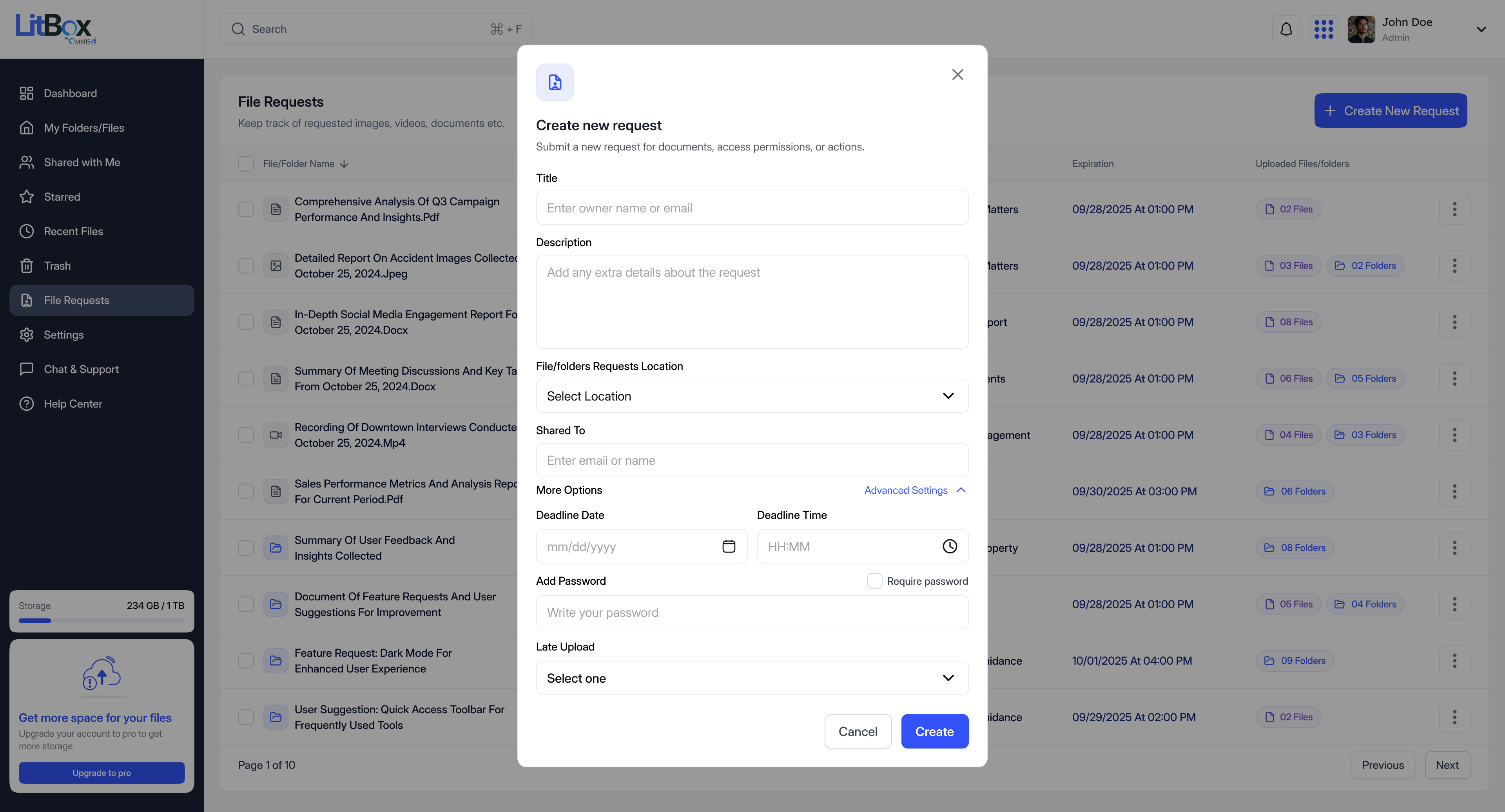
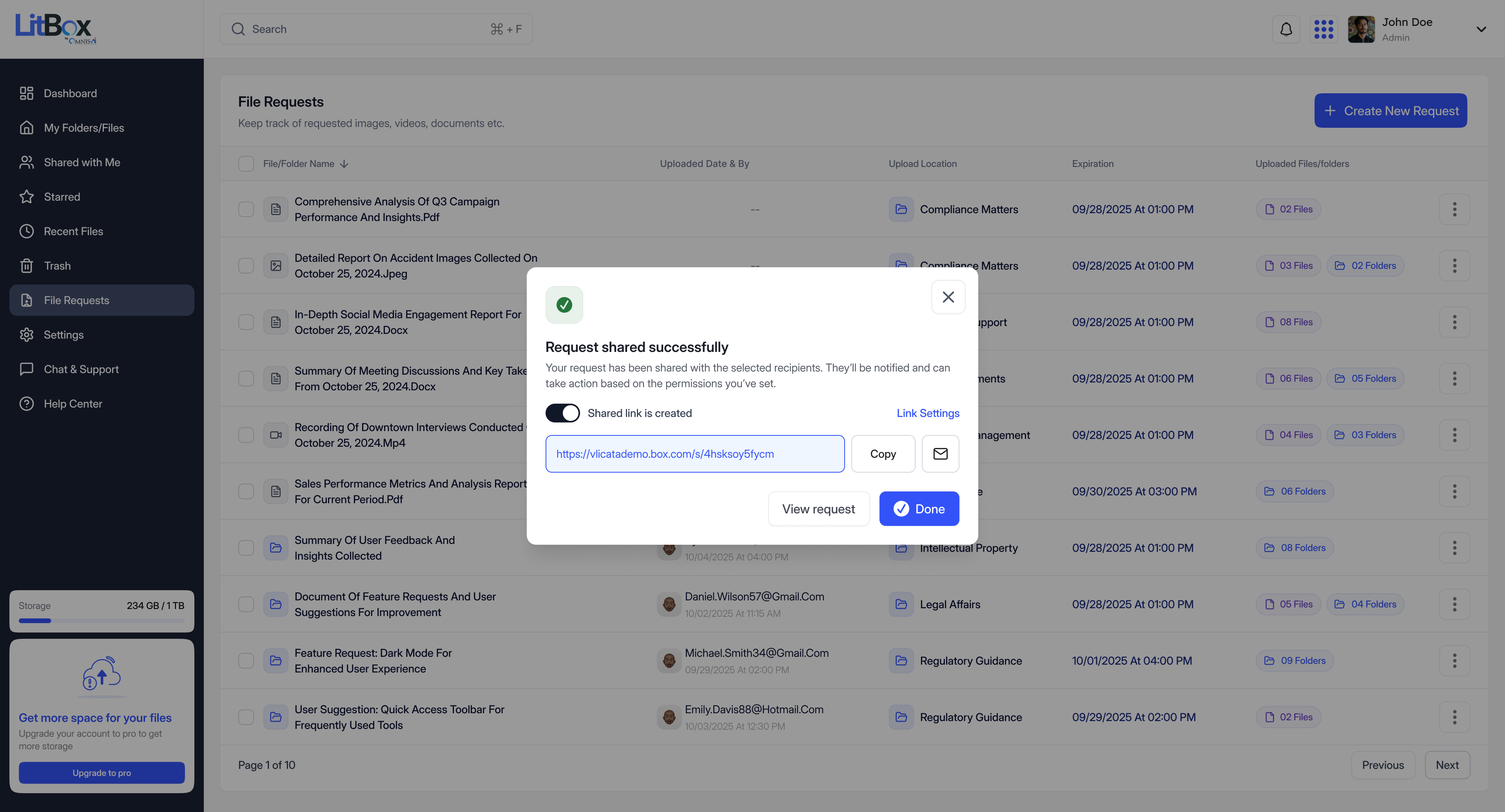
Uploading into a File Request, end to end. A paralegal opens File Requests → Create New Request, sets a title, a destination folder, an optional deadline and password, and shares it with an external email. The recipient never needs a LitBox account — they land on a scoped upload page. Once submitted, the files route straight into the destination folder, and if that folder is AutoDoc-connected, processing starts without anyone re-uploading anything.

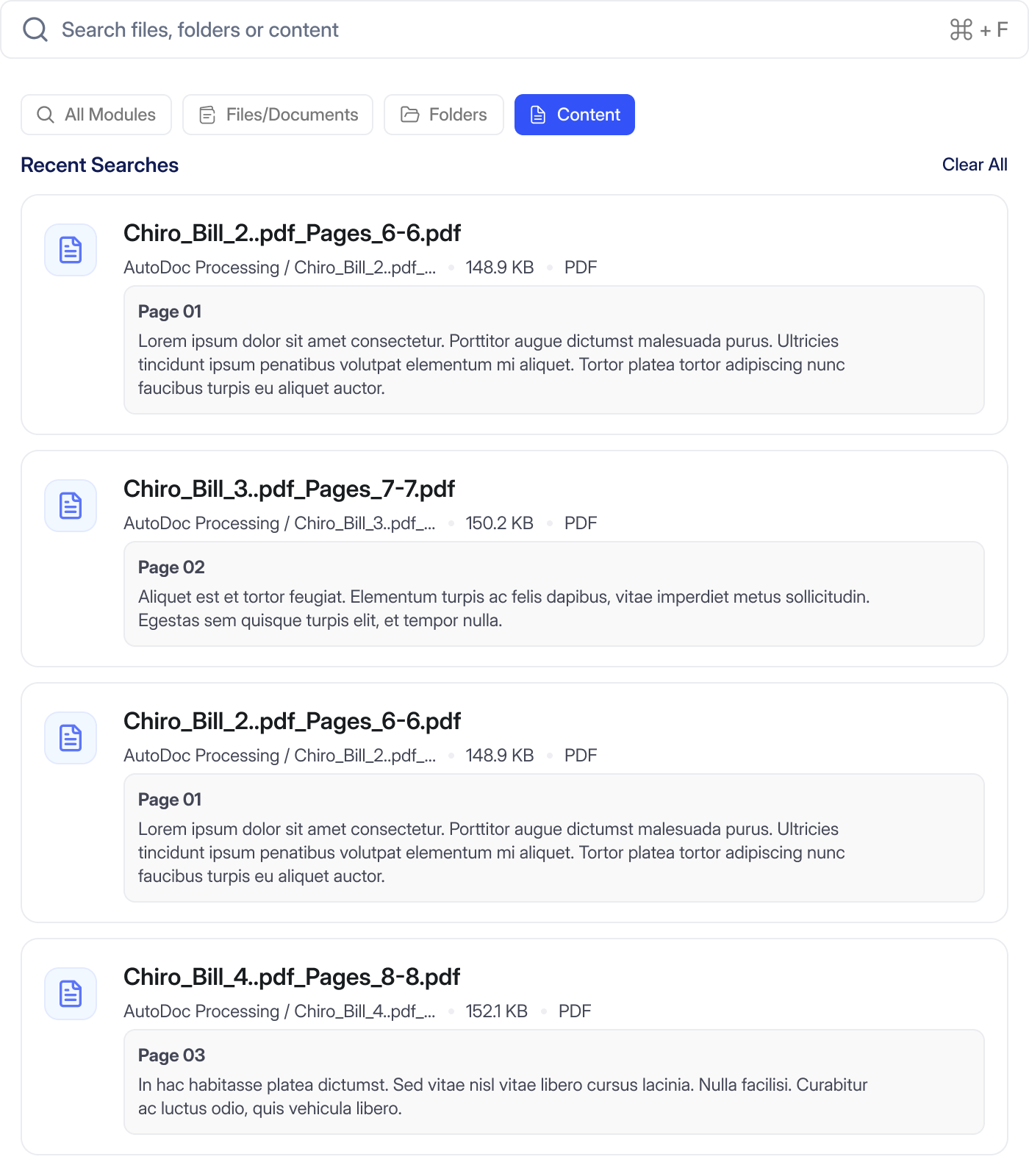
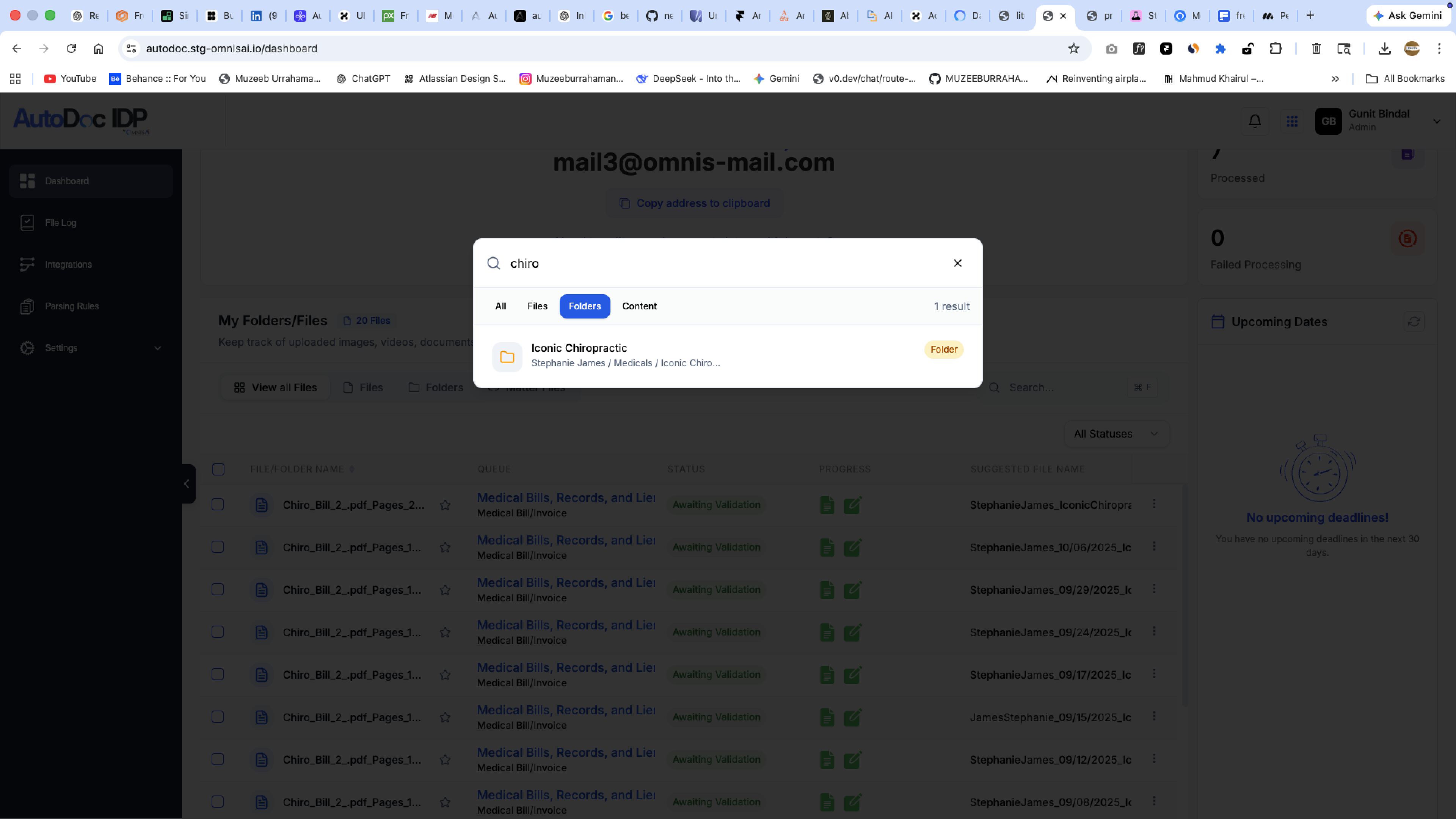
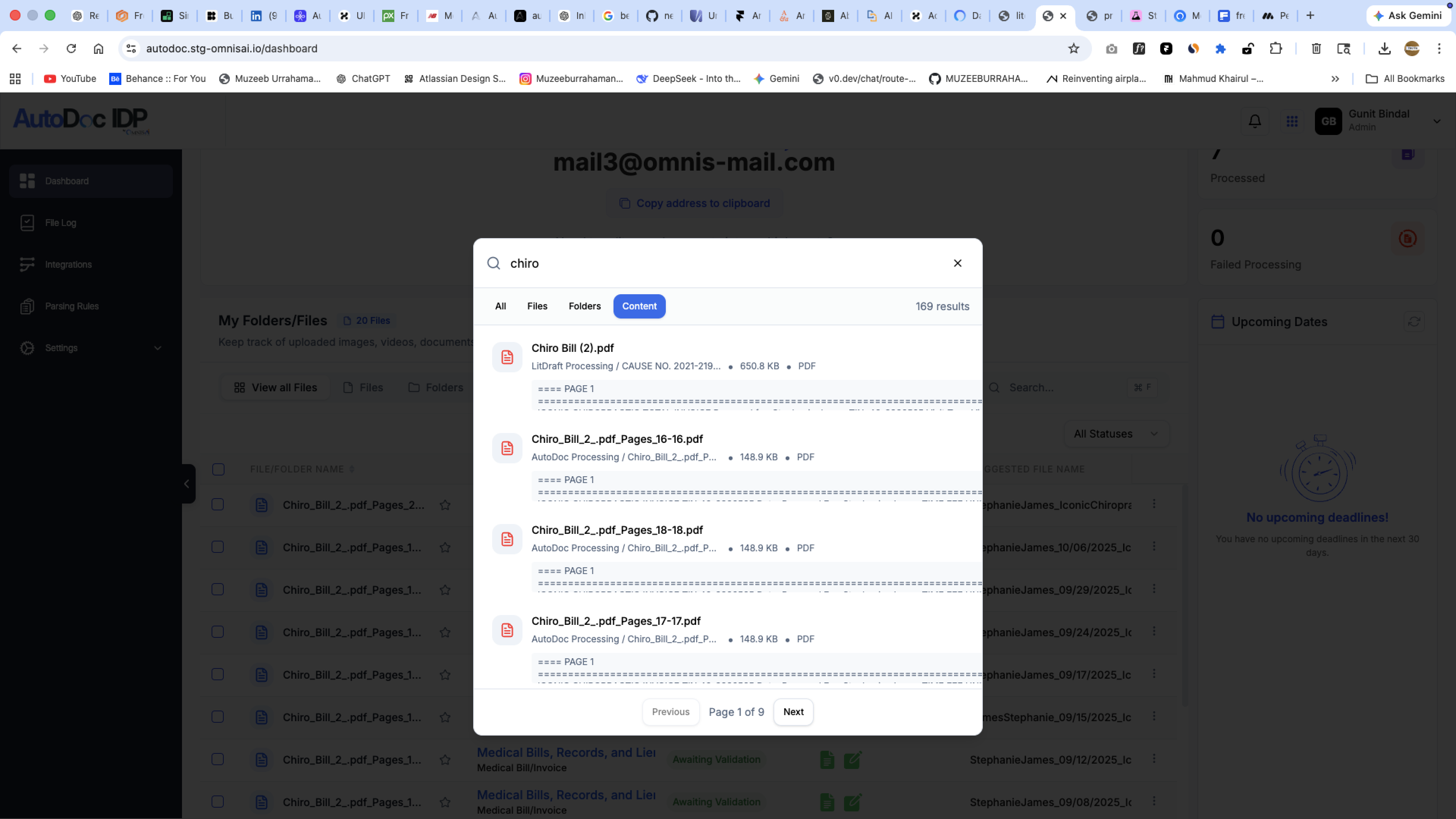
Content search across a matter. Typing into global search surfaces results scoped to Files/Documents, Folders, or Content — the Content tab searches inside text AutoDoc has already extracted, showing the source file, the specific page, and a highlighted snippet, so a user can judge relevance before opening anything.

coreFlows A · FILE REQUEST → AUTODOC PICKS IT UP File Requests List Create New Request External Submitter Uploads No account needed AUTO AutoDoc Documents Folder Auto-processed B · SEARCH A MATTER BY CONTENT Global Search — Content Results: Page + Snippet Traceable to source Source Document Opens
Both flows shown exactly as designed. The "AUTO" tags mark the one step in each flow that requires no user action — AutoDoc picking up a submitted file, and a search result carrying its source page along with it.
09 / THE WORKSPACE
Dashboard & File Management

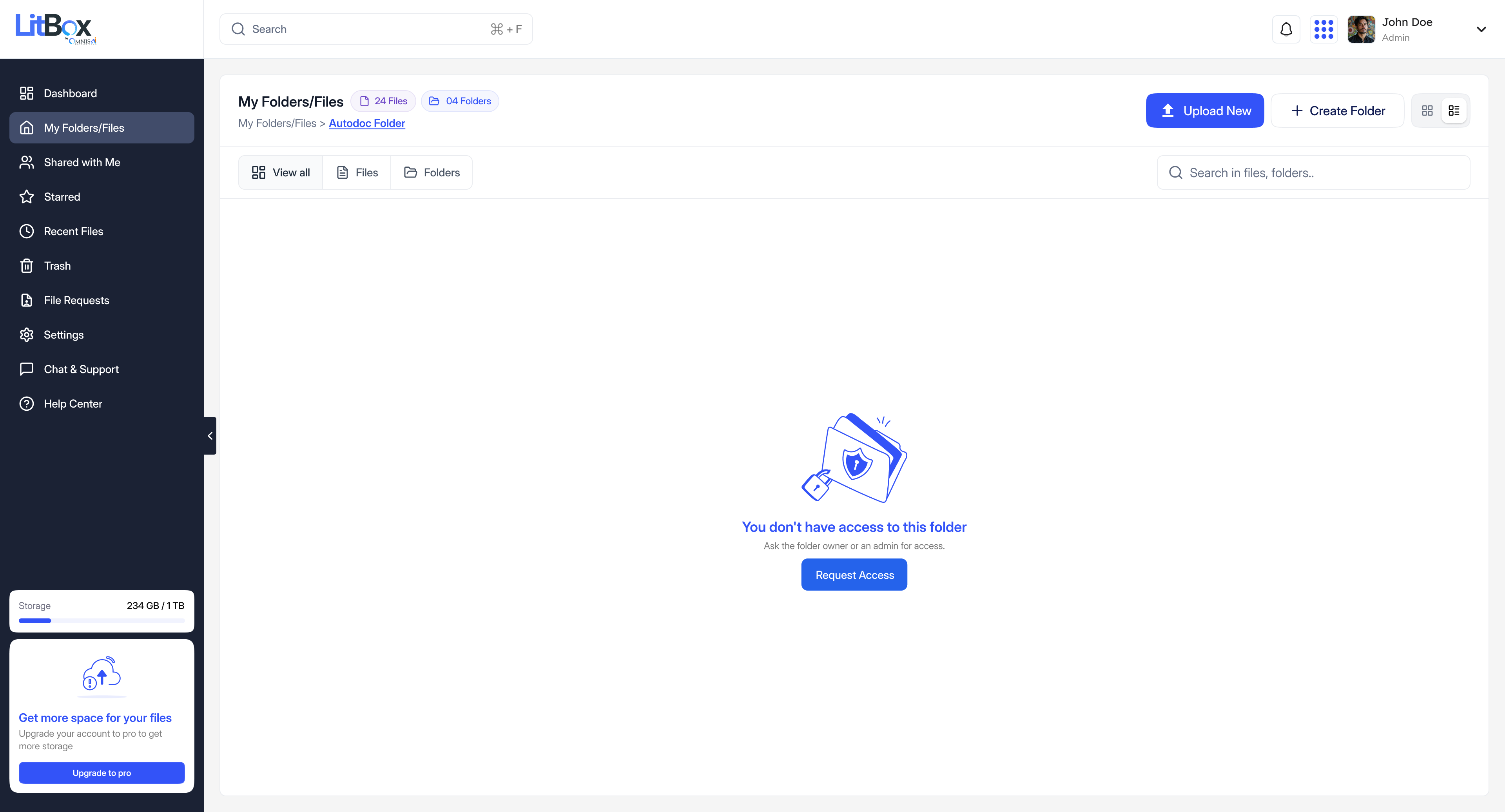
Designing for the file, and for the moment someone can't access it

Most of a file-management product's design work isn't the happy path — it's what a grid looks like with zero files in it, what happens when someone opens a folder they don't have permission for, and what a delete confirmation says when the action can't be undone after a set window. LitBox's Figma file has more than two dozen empty, error, and permission states designed up front, across core file management, sharing, search, audit, and admin — that scope shaped the workspace as much as the dashboard did.
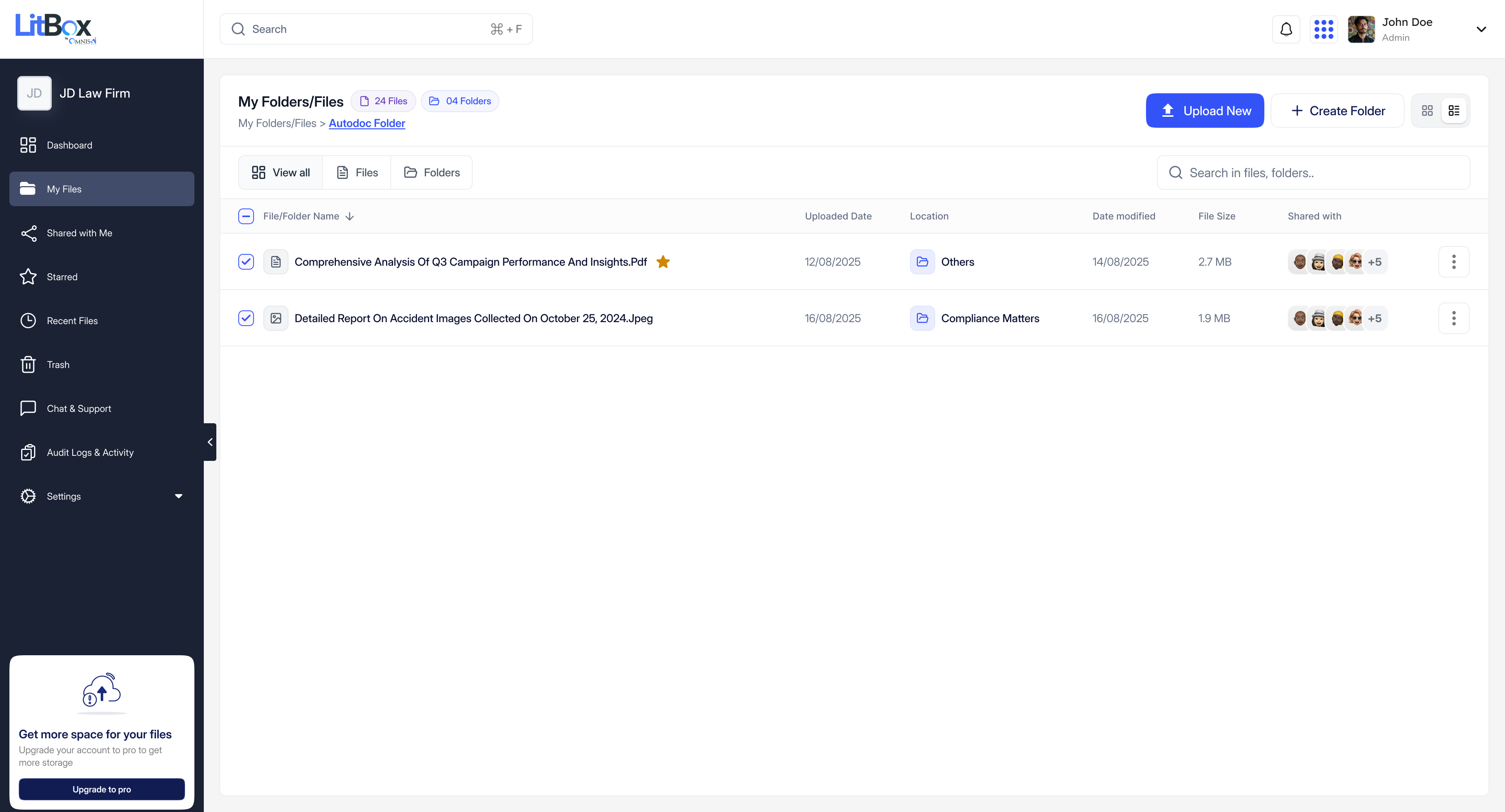
LitBox My Folders/Files screen showing a populated file list inside an Autodoc Folder, with columns for File/Folder Name, Uploaded Date, Location, Date Modified, File Size, and Shared With, and an organization switcher reading JD Law Firm in the sidebar
DesignMy Folders/Files, populated. An organization switcher in the sidebar ("JD Law Firm") reflects that LitBox is multi-tenant by firm, not a single personal drive — the same file list view supports grid and list layouts and a breadcrumb trail back to the parent folder.
LitBox folder view showing a You don't have access to this folder empty state with a Request Access button, inside the Autodoc Folder breadcrumb
DesignPermission denial, not a dead end. Explains why, and offers a direct path to request access.

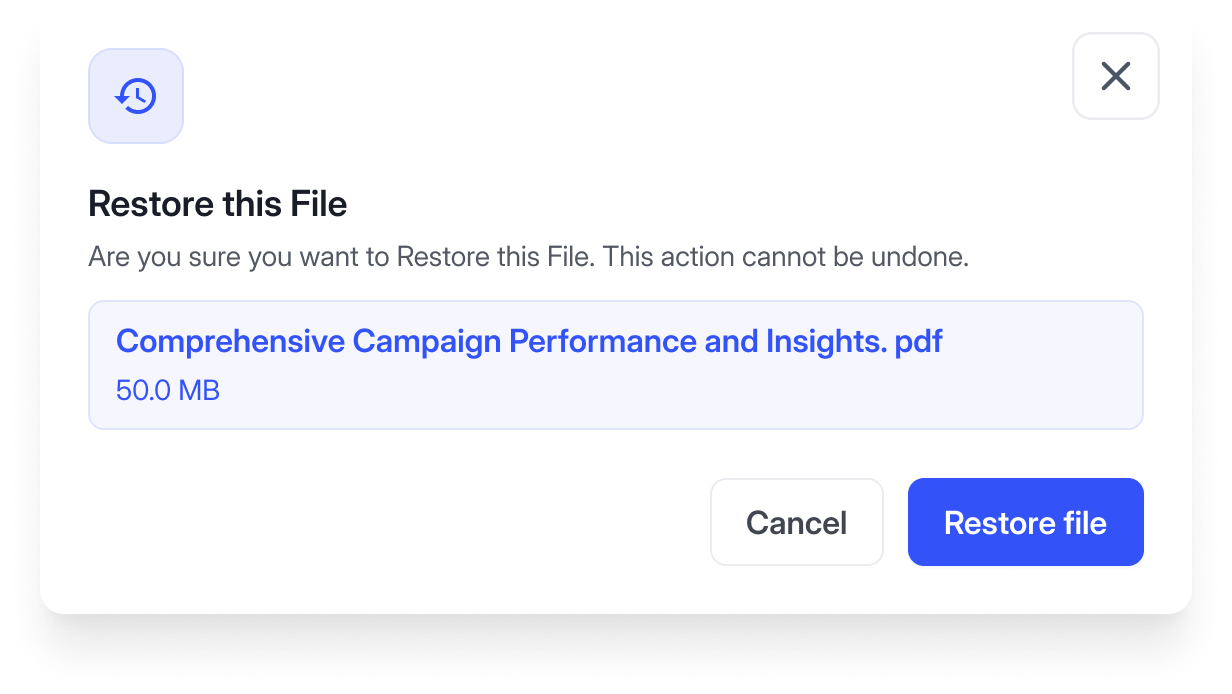
Three Small Decisions, Kept Small On Screen

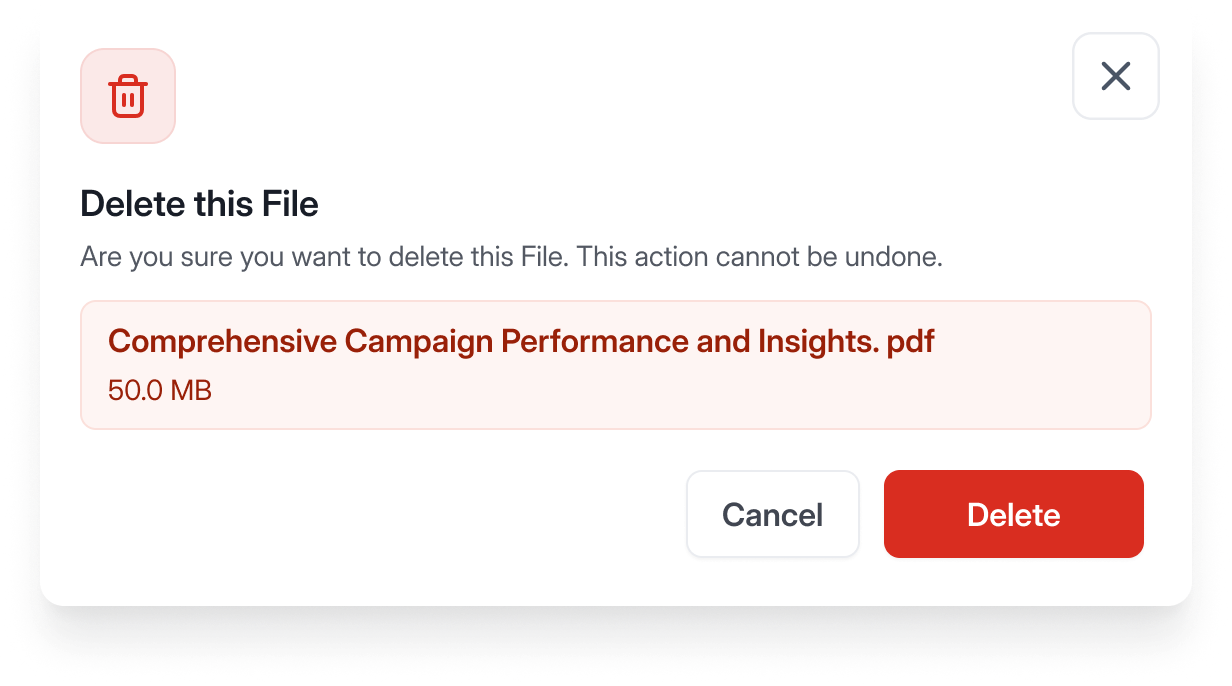
Upload favors clarity over cleverness. Restore stays quiet — reversible, one click. Delete inside the retention window costs a second's friction on purpose, so nothing sensitive disappears silently.
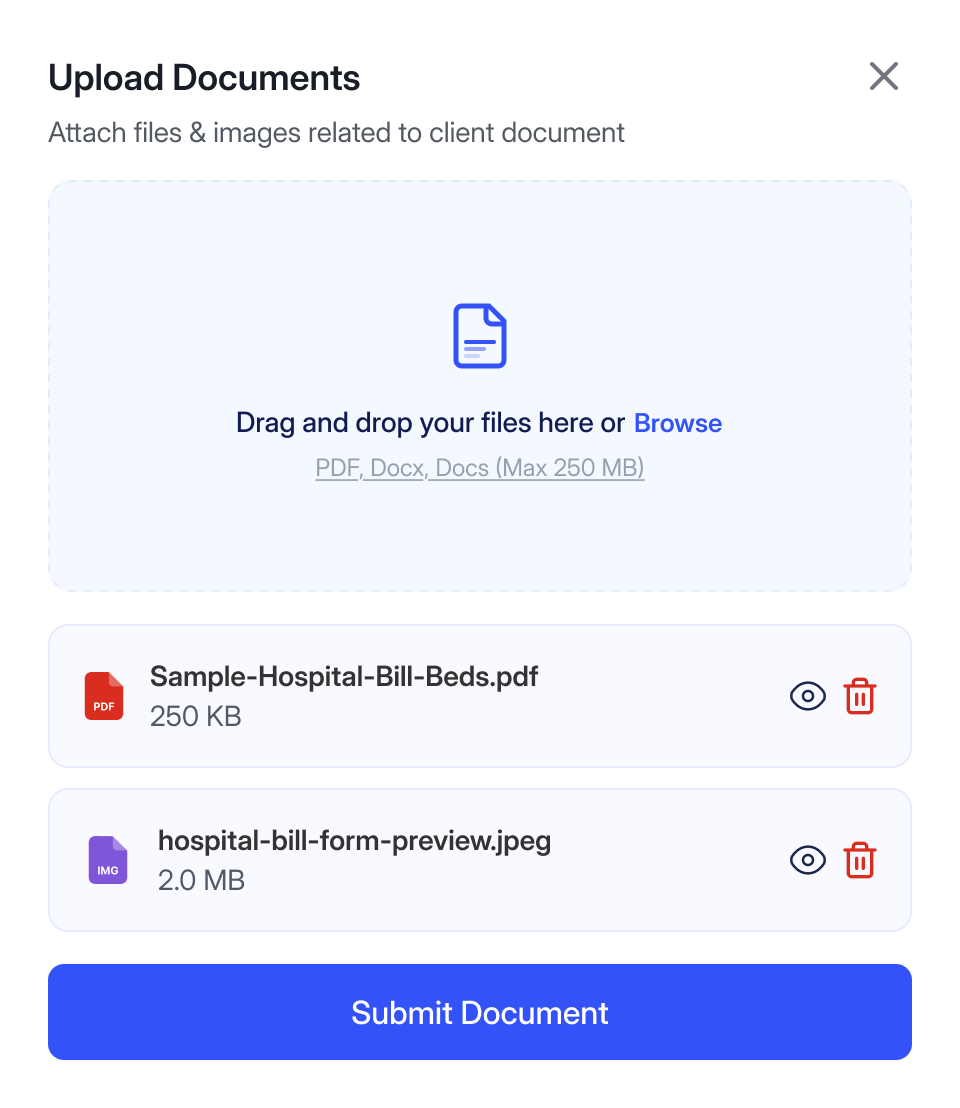
LitBox upload documents modal
DesignUpload
LitBox Restore this File confirmation modal
DesignRestore — reversible
LitBox Delete this File confirmation modal
DesignDelete — one extra step

The Audit Timeline — the One Security Surface Actually Built

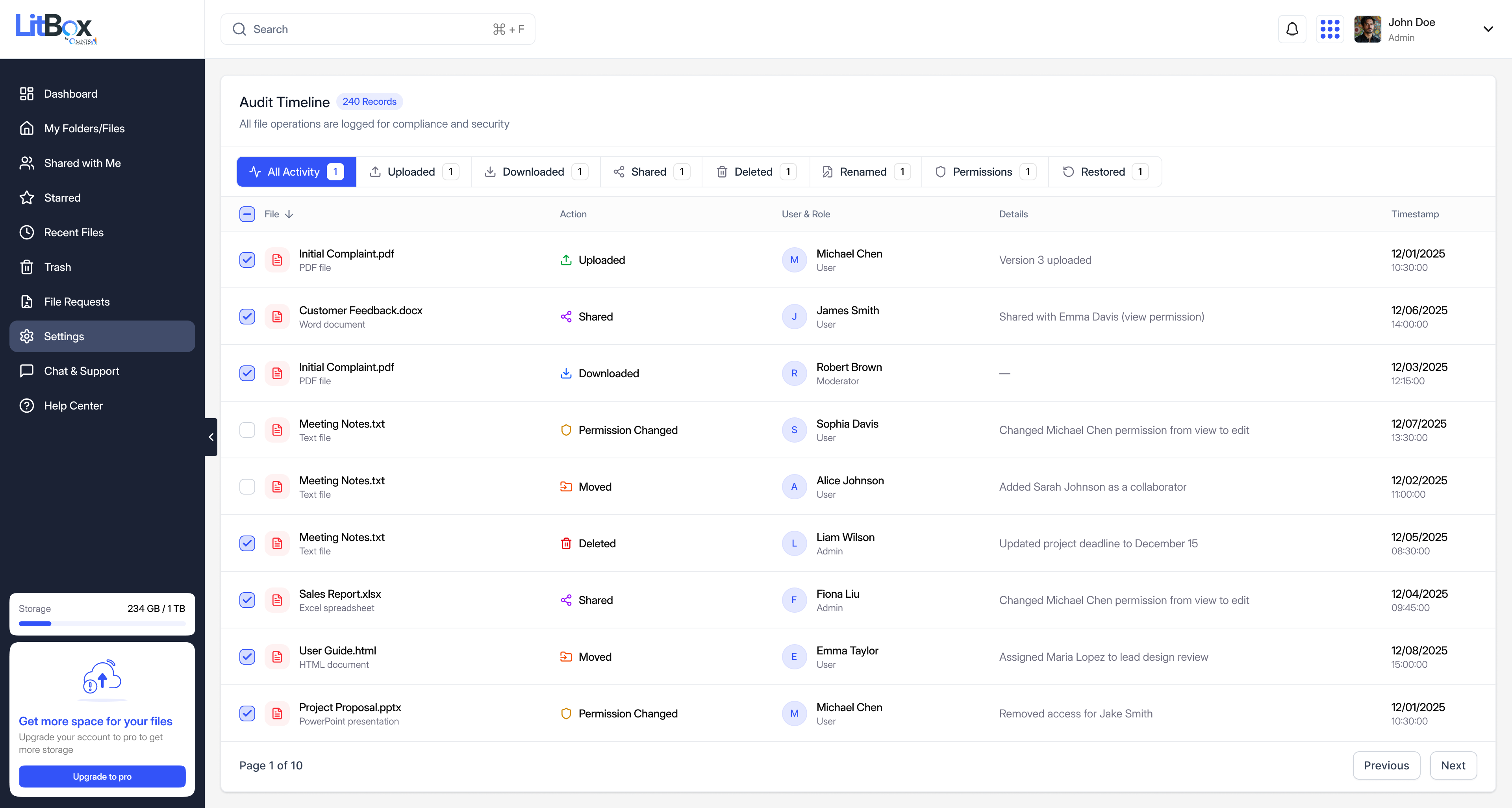
Every upload, download, share, rename, permission change, and restore is written to a single timeline, filterable by action type, with the file, the user and role, and a timestamp on every row. This is the one piece of Section 03's security discussion that isn't a proposed capability — it's built, and it's the concrete answer to "how would a firm know who touched a file."
LitBox Audit Timeline screen with filter tabs for All Activity, Uploaded, Downloaded, Shared, Deleted, Renamed, Permissions, and Restored, and a table listing real actions — uploads, shares, downloads, permission changes, moves, and deletes — each with a file, an action, a named user and role, details, and a timestamp
DesignAudit Timeline, populated. Every row pairs a file with an action, a named user and role, and a timestamp — "Sophia Davis changed Michael Chen's permission from view to edit," "Liam Wilson deleted Meeting Notes.txt." That level of specificity is what turns "we log activity" from a claim into something a firm could actually hand to a compliance reviewer.

Admin Gets a Different Dashboard, Not a Hidden Toggle

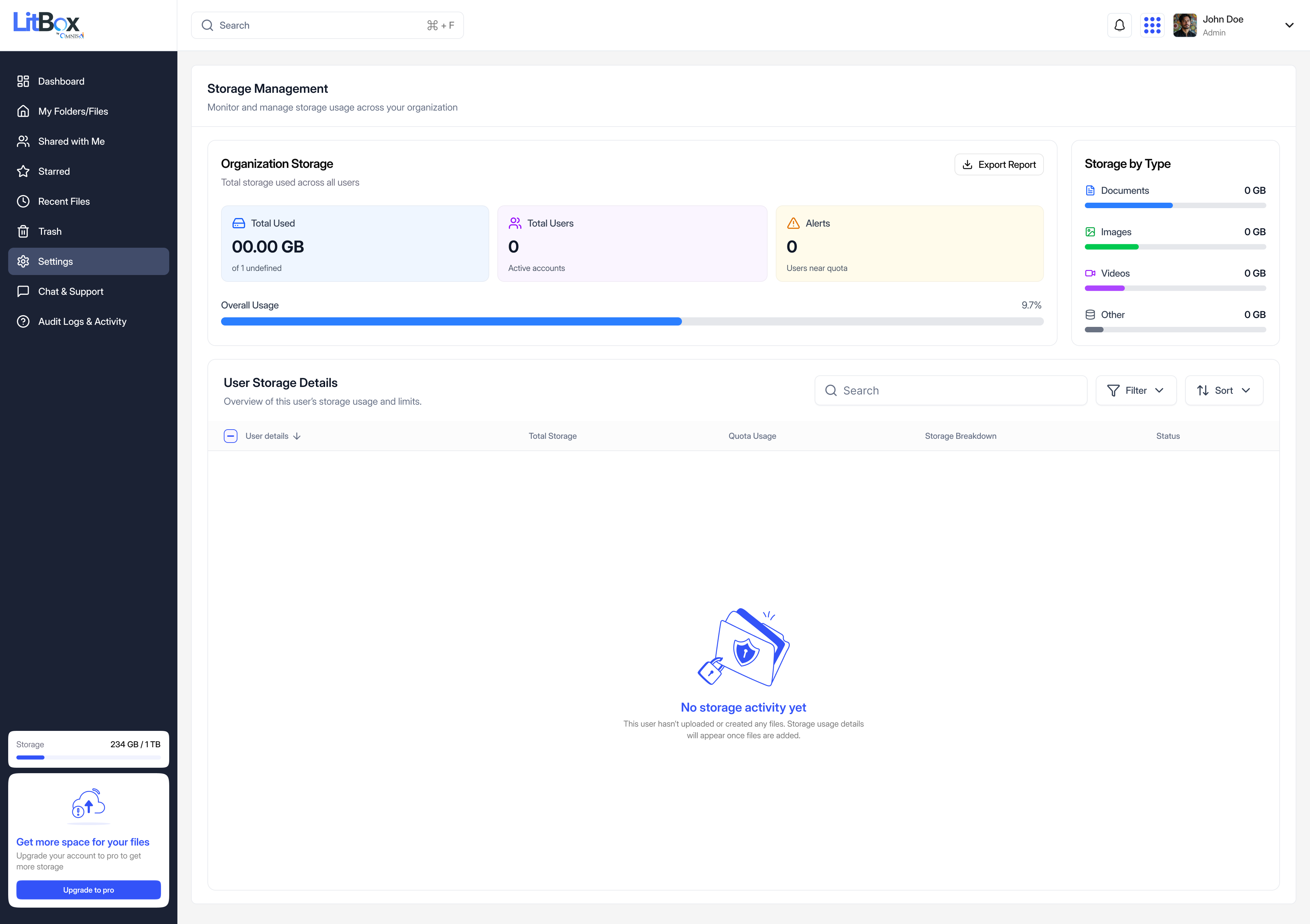
Storage Management is a separate surface for firm admins — total usage, storage by file type, per-user breakdowns, and quota alerts — rather than a setting buried inside the same view every attorney and paralegal sees. Keeping it separate meant the day-to-day file workspace never had to compromise its simplicity to accommodate governance features most users will never open.
LitBox Storage Management admin screen showing organization storage totals, total users, alerts, storage by file type, and a user storage details table
DesignStorage Management (admin). Export Report, per-type storage breakdown, and a searchable/sortable user storage table — built for the firm admin persona, not the daily file user.
Real Iteration, Not Just a First Draft A dedicated UI-testing pass on these screens produced direct, unglamorous feedback I then designed against — things like tightening card padding, applying minimum card widths so a grid doesn't collapse awkwardly on narrower viewports, adding tooltips for truncated file and folder names instead of letting them clip silently, and standardizing sidebar and header components against the shared component library rather than letting each screen drift. None of that shows up in a polished screenshot, but it's the difference between a mockup and a system someone else can extend.
11 / THE ECOSYSTEM
LitBox + Omnis AI

The part of this product that only makes sense next to the rest of the platform

This section is about LitBox handing files off to the rest of the platform — Section 12 covers the opposite direction, LitBox's own interface running inside other products. Two integrations here are built and working in the current prototype, not proposed on a roadmap slide: File Requests feeding AutoDoc, and e-signature launched directly from a document. Both are shown below exactly as designed.

File Requests → AutoDoc

A File Request isn't just "share a link and wait." It has a title, a description, a destination folder, an optional deadline, password protection, and a defined recipient — and when that destination folder is an AutoDoc-connected folder, submitted files are positioned to be picked up for processing without anyone manually forwarding them.
E-Signature, Launched in Place

Opening a document that needs a signature surfaces a "Continue to e-signature" action that hands off directly into OmnisProof's signer setup — general info, signer list, extra fields, and distribution — without exporting the file and re-uploading it into a separate tool.
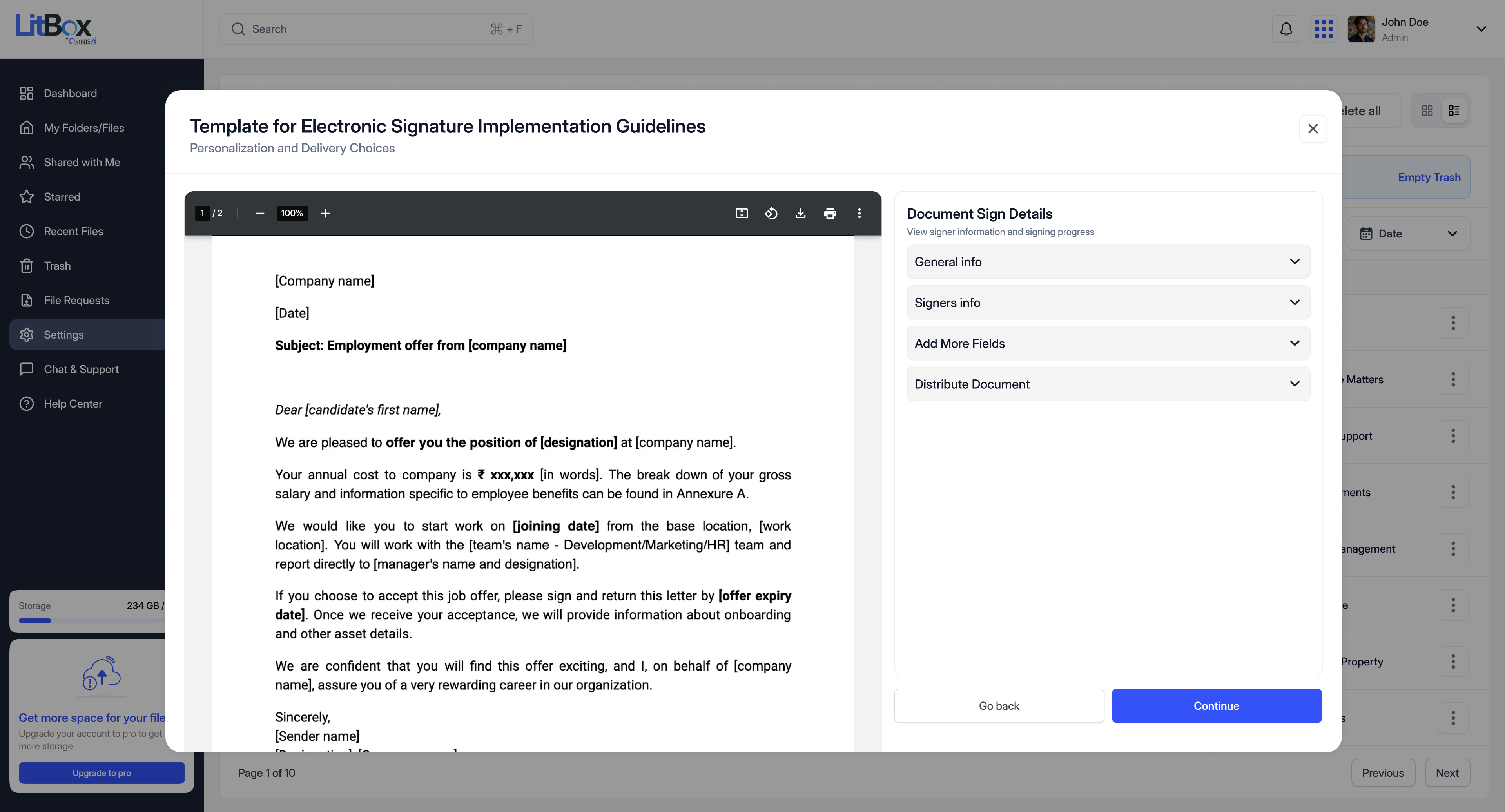
LitBox document view with an OmnisProof e-signature setup modal open on top, showing document sign details with general info, signers info, add more fields, and distribute document sections
DesignOmnisProof, one click from a LitBox document. The document underneath stays visible and dimmed — a deliberate cue that this is a continuation of the same file, not a handoff to an unrelated tool.

Still proposed, not implemented: CasePro matter-linking and a shared permission model spanning the whole ecosystem. MedChron and LitDraft, it turns out, are further along than that — see the next section.

12 / LITBOX EVERYWHERE
Embedded, Not Just Linked

The same search bar, running inside three other products

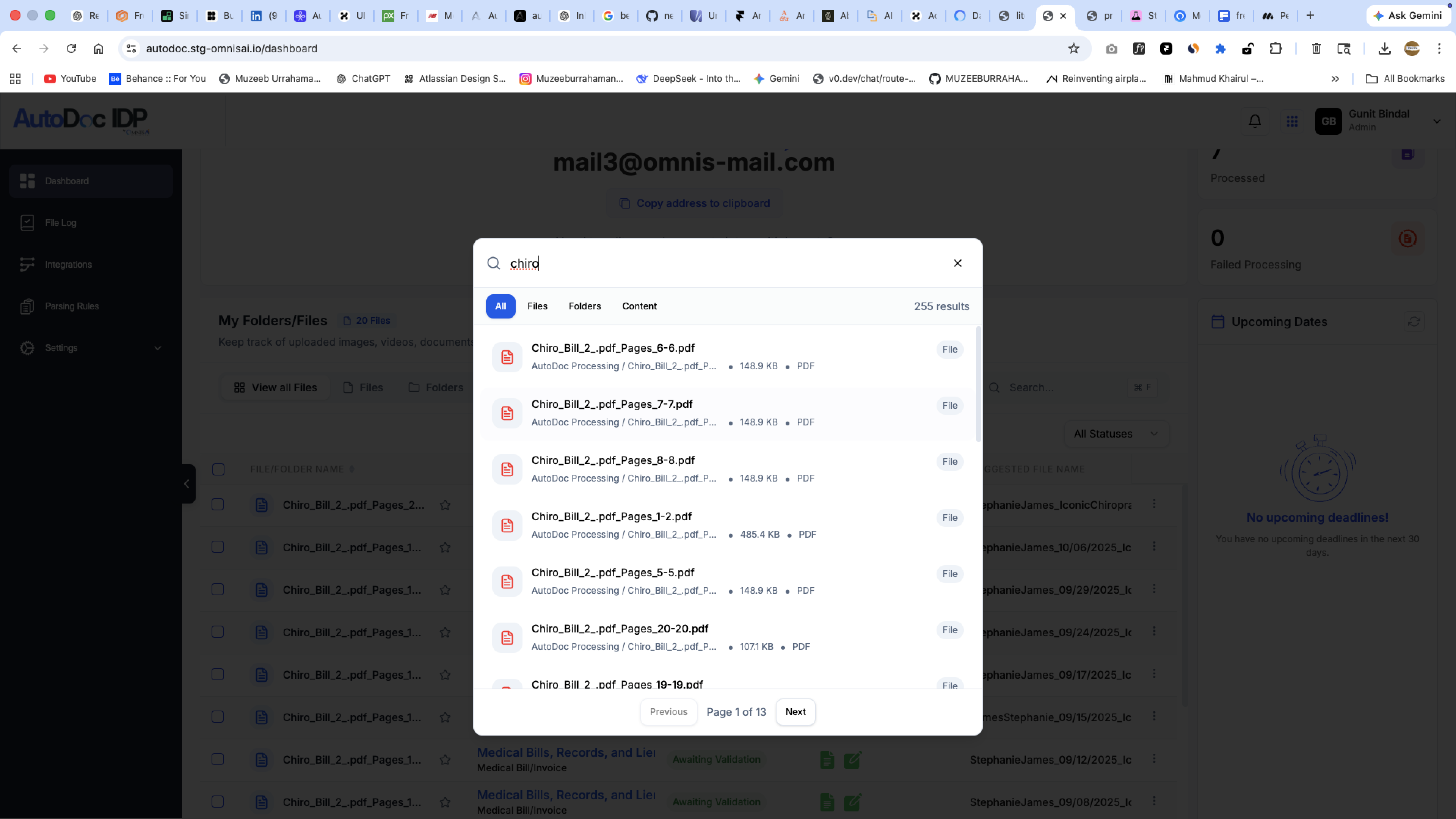
Search doesn't have to mean leaving the tool you're already in — that was the design brief in so many words, down to the internal Figma section literally named "avoid context switching." LitBox's search is embedded directly inside other Omnis AI products, and what follows are staging screenshots of the real thing, not mockups.
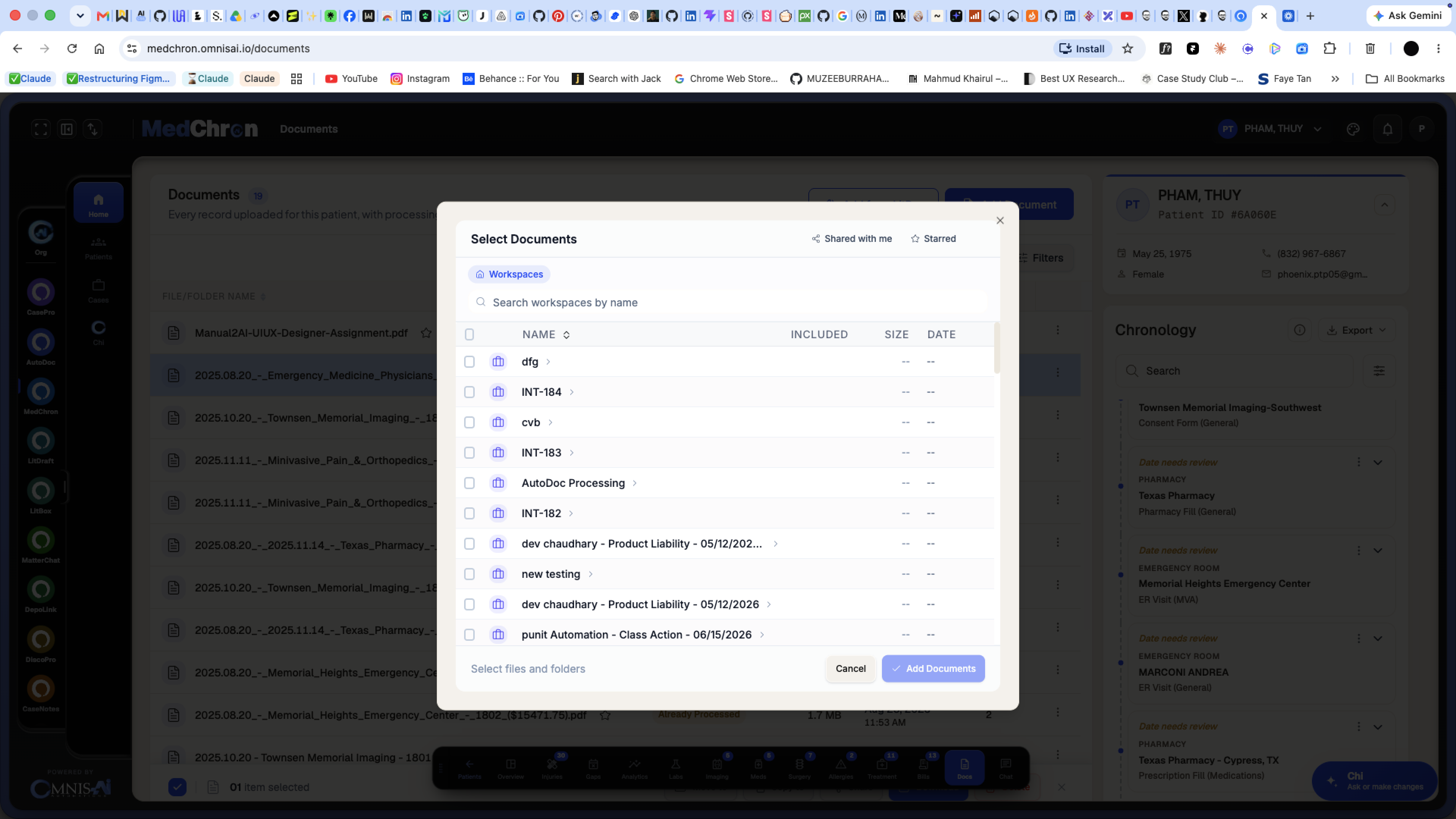
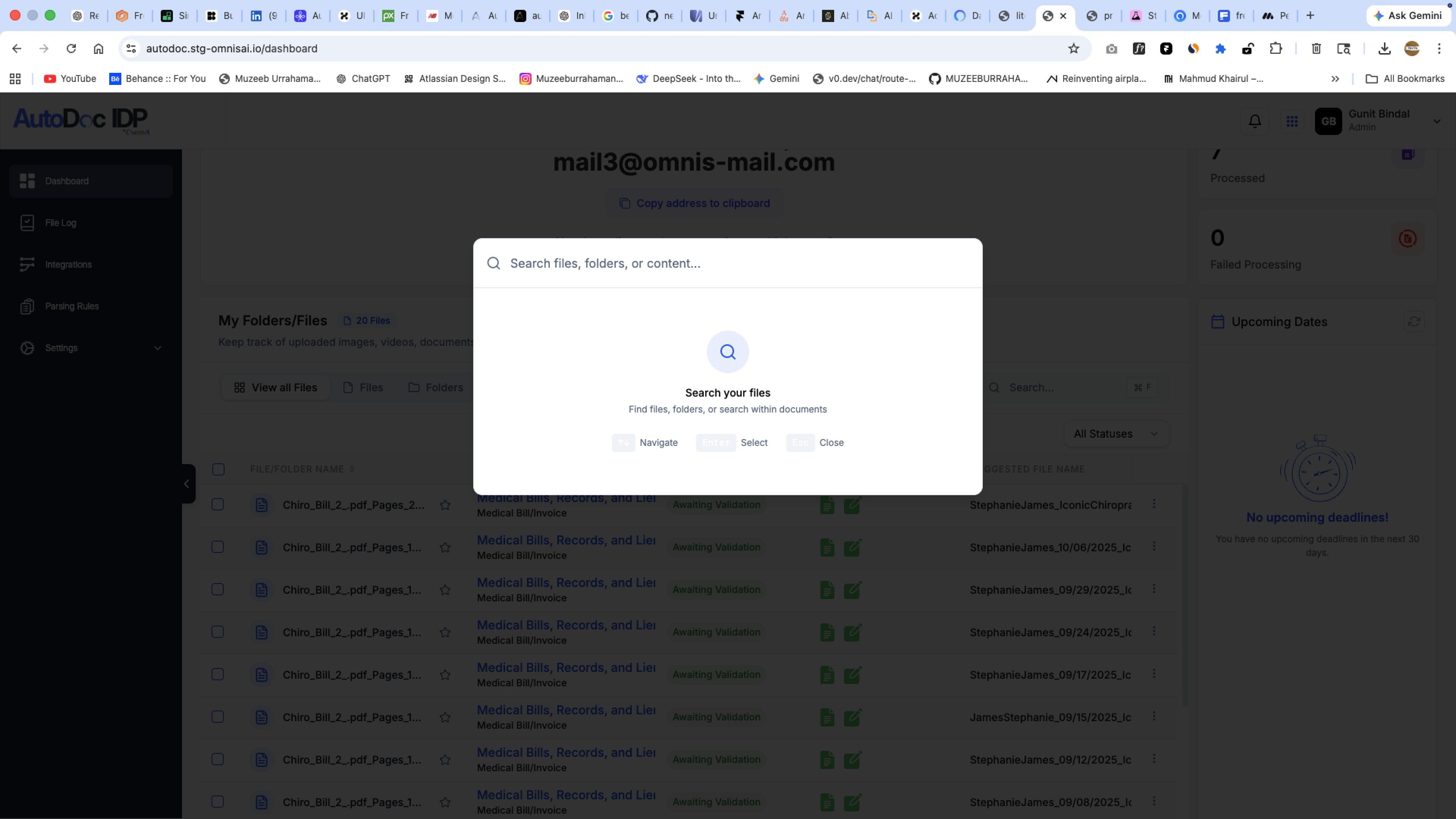
MedChron Documents page with a LitBox Select Documents picker modal open, showing a workspace file browser with Shared with me and Starred tabs
LiveInside MedChron. Attaching a record pulls up LitBox's own file browser as a picker — no export, no separate tab.
Why This Is the Strongest Evidence in the Case Study Everything else here is a Figma prototype. This is four different real products — LitBox, MedChron, AutoDoc, LitDraft — each showing up correctly inside a screen that isn't theirs.
13 / PRODUCT VALUE
Why Would a Firm Switch

A balanced case, not a "we're just better" claim

"Lawyers will switch because LitBox is more secure" isn't a defensible claim — Drive, Dropbox, and Box are all reasonably secure products. The actual case for LitBox has to rest on something more specific.

What Would Motivate a Switch

  • Already using AutoDoc or OmnisProof and tired of re-uploading the same file into each one.
  • Need an audit trail for file activity that a general drive doesn't natively provide.
  • Want File Requests with expiry and password controls instead of an open-ended public link.
  • Consolidating tools rather than adding one more login to an already-fragmented stack.

What Would Stop a Switch

  • Migration effort — years of files already organized in an existing drive.
  • No SOC 2, HIPAA, or other third-party certification to point to yet.
  • Missing desktop sync, mobile apps, and the Microsoft 365 / Google Workspace integrations firms already depend on.
  • Trust in an early-stage internal-beta product versus an incumbent with a decade of track record.

The defensible pitch isn't "more secure" — it's "the file layer that gets more useful the more of Omnis AI you already use." That's a narrower claim, and it's one the File Requests → AutoDoc and in-document e-signature flows can actually back up today.

14 / IMPACT & LEARNINGS
Where This Stands

What I can claim, what I can't yet, and what I'd do differently

Impact — Honestly Framed

Measured

None yet. LitBox is in internal beta with no usage baseline to report — I'm not going to invent adoption numbers or time-savings percentages to make this section look stronger.

Observed

AutoDoc and OmnisProof integrations work end to end in the prototype, and staging screenshots confirm search is already live inside MedChron and AutoDoc. A structured UI-QA pass produced concrete, actionable fixes I designed against — real iteration, even without formal usability-test data.

Expected

Reduced re-uploading across AutoDoc/OmnisProof workflows, a defensible audit trail for firms handling sensitive files, and fewer uncontrolled public links — all hypotheses to validate once real usage exists, not claims to make today.

My Role

I owned LitBox's product design end to end: the competitive and module-architecture research that scoped what "parity with Dropbox and Box" actually required, the information architecture, the full UI system across file management, sharing, search, audit, and admin, and the design of its live ecosystem connections into AutoDoc, OmnisProof, MedChron, and LitDraft. The empty-state, error-state, and permission-state documentation — more than two dozen scenarios specified before a single one shipped — was mine to define, not a gap engineering had to fill in later.

What I Learned

Shared infrastructure is a different job

  • LitBox's users aren't just attorneys and paralegals — they're also AutoDoc and OmnisProof. A broken assumption in a file's metadata breaks someone else's product, not just this one.

A parity checklist isn't a strategy

  • The Dropbox/Box feature-parity research was necessary groundwork, but the real differentiation came from two questions a parity table can't answer: which matter does this belong to, and who downstream needs it.

Security language has to earn its claims

  • It was easier to write "SOC 2 compliant" into an early feature list than to confirm it was true. Separating planned from verified capability was a discipline I had to actively maintain, not a default.

Edge cases first is what makes it feel real

  • Designing 25+ empty and error states before the happy path ships is the difference between a prototype and a demo that only works when everything goes right.
LitBox's real test isn't whether its file grid looks as good as Dropbox's. It's whether AutoDoc and OmnisProof keep needing fewer workarounds the more of it ships — that's the metric an infrastructure product actually has to answer to.
NEXT CASE STUDY

CaseNotes: AI Meeting Notetaker for Lawyers

How I designed a specialized AI transcription and synthesis workspace that anchors client conversations directly to litigation discovery files.